
Understanding the 2e brain: Why gifted and neurodivergent minds feel so contradictory

Have you ever looked at your life and wondered how both of these things can be true?
You can solve incredibly complex problems.
Yet replying to a simple email feels impossible.
You can see patterns that nobody else notices.
Yet forget to eat until three o’clock because you’ve become completely absorbed in what you’re doing.
You can spend hours researching a topic that fascinates you.
Yet stand in the supermarket feeling completely overwhelmed by deciding what to cook for dinner.
People tell you how capable you are.
Meanwhile, you’re quietly wondering why everyday life feels so much harder than it seems to be for everyone else.
If this sounds familiar, I want you to know something.
You’re not lazy.
You’re not disorganised.
You’re not lacking discipline.
And you’re certainly not broken.
You may simply have a twice-exceptional, or 2e, brain.
Understanding what that means can completely change the way you see yourself.
Because so many of the things you’ve spent years criticising yourself for aren’t character flaws at all.
They’re clues.
Clues to how your brain and nervous system are wired.
In this guide
If you’ve ever wondered why you can be incredibly capable one moment and completely overwhelmed the next, you’re in the right place.
This guide explores what it really means to have a twice-exceptional (2e) brain - and why gifted and neurodivergent minds often experience the world so differently.
Whether you’re recognising yourself, your child, or both, here’s what we’ll cover:
What does “twice-exceptional (2e)” actually mean?
Discover why being both gifted and neurodivergent can feel so contradictory, and why so many adults aren’t recognised until later in life.
Understanding the spiky profile
Learn why extraordinary strengths and genuine challenges can exist side by side - and why one never cancels out the other.
Overexcitabilities: when your nervous system feels everything
Understand why emotions, thoughts, creativity, movement, and the senses can all feel more intense - and why this is far more than simply being “too sensitive.”
Sensory seeking and sensory avoidance
Discover why some environments feel calming while others feel overwhelming, and why many twice-exceptional people naturally seek out activities that help regulate their nervous system.
Interoception: listening to your body
Learn why you might miss signals like hunger, thirst, fatigue, or stress until they become impossible to ignore - and how strengthening body awareness can reduce burnout.
Alexithymia: when feelings are difficult to name
Understand why identifying your emotions isn’t always straightforward, even when you experience them deeply.
Executive function and decision fatigue
Explore why planning, organising, starting tasks, and making everyday decisions can feel disproportionately exhausting - and why this isn’t a reflection of your intelligence or motivation.
Burnout in the twice-exceptional brain
Learn why so many gifted and neurodivergent adults reach a point of complete exhaustion, and why burnout is often a nervous system response rather than a personal failure.
Discover practical ways to work with your wiring instead of against it, so you can create a life that feels more sustainable, compassionate, and aligned with who you are.
Find answers to some of the most common questions about giftedness, twice-exceptionality (2e), executive function, overexcitabilities, sensory processing, and the gifted nervous system.
Reading this as a parent?
Throughout this guide, you’ll find examples that help you recognise these patterns in yourself and your child. Many parents discover their own twice-exceptionality while trying to understand their child’s - and that recognition can be the beginning of healing for the whole family.

What does “twice-exceptional” (2e) mean?
A twice-exceptional (2e) person is someone who is both gifted and neurodivergent.
That neurodivergence might include ADHD, autism, dyslexia, dyspraxia, dyscalculia, or another difference in how the brain processes information.
At first glance, those two parts can seem like they cancel each other out.
Your giftedness may hide your challenges.
Your challenges may hide your giftedness.
Neither makes the other any less real.
The result?
Many 2e adults spend years feeling as though they don’t quite fit anywhere.
You’re often “too much” for one group.
Yet somehow “not enough” for another.
People see your intelligence.
They don’t see the effort it takes to hold everything together.
Or they see the struggles and assume you’re not capable.
Very few people see both.
Living with that contradiction can have a profound impact on how you see yourself.
You might develop imposter syndrome because everyone around you assumes things come easily, while you know how much energy it takes just to keep up.
You may be exceptional at what you do, yet stay quiet in meetings because by the time you’ve organised your thoughts, the conversation has already moved on.
You might have ideas that are insightful, original, and deeply perceptive, but struggle to express them in a way that other people immediately understand.
Over time, it’s easy to begin questioning yourself.
“Maybe I’m not as capable as people think.”
“Maybe I’m actually failing.”
“Maybe I’m not intelligent after all.”
When your strengths are obvious but your challenges are invisible, it’s easy to feel like you’re constantly falling short of your own potential.
Not because you lack ability.
But because many environments are designed around a very narrow window of how people are expected to think, communicate, and contribute.
If you need more time to process, people may not always recognise the depth of what is happening beneath the surface. They may move on before you’ve had the chance to organise your thoughts and express what you really mean.
But if your mind moves incredibly quickly, you can experience the opposite problem.
You might see patterns, connections, or outcomes long before anyone else does. You may have mentally skipped five steps ahead and arrived at a conclusion that feels obvious to you - but others haven’t had time to travel that path with you yet.
Sometimes they catch up later.
Sometimes they don’t.
And that can be incredibly isolating.
Understanding your 2e profile helps explain this contradiction.
It reminds you that struggling to express your brilliance is not the same as lacking it.
Can you relate?
You might recognise yourself if:
People describe you as incredibly capable, while you quietly feel like you’re working twice as hard behind the scenes.
You swing between periods of intense productivity and complete exhaustion.
You understand difficult concepts quickly but struggle with everyday organisation.
You crave challenge and complexity, yet become overwhelmed by ordinary life.
You can hyperfocus for hours on something you love but forget to eat, drink, or rest.
You’ve spent years wondering why some things come so naturally while others feel almost impossible.
You don’t need to recognise yourself in every point.
But if several of them feel familiar, you’re not alone.
And you’re certainly not the only person asking:
“How can I be so capable… and yet struggle with something that looks so simple?”

Your brain isn’t broken. It’s processing more.
When people hear the words gifted or neurodivergent, they often think about intelligence, learning differences, or attention.
But underneath all of those experiences sits something even more important:
Your nervous system.
And once you understand your nervous system, so many things that once felt confusing begin to make sense.
A twice-exceptional nervous system isn’t simply taking in more information.
It’s often processing information more deeply, more intensely, and across more channels at the same time.
You may notice subtle changes in someone’s tone of voice before anyone else does.
You may spot patterns that other people completely miss.
You may think several steps ahead in a conversation, a project, or a problem.
You may also become overwhelmed more quickly by noise, busy environments, constant decision-making, or emotional intensity.
The same nervous system that gives you extraordinary insight can also leave you feeling exhausted by everyday life.
But overwhelm isn’t the only thing that can drain a gifted and neurodivergent brain.
A lack of stimulation, challenge, meaning, or growth can be just as difficult.
Many twice-exceptional people don’t just need rest.
They also need engagement.
A mind designed to explore, question, create, and solve problems can begin to struggle when it’s placed in environments where it feels underused or disconnected.
This is sometimes described as boreout - a state of exhaustion that comes not from doing too much, but from spending too long without enough meaningful stimulation.
Because for a 2e nervous system, both extremes can be draining:
Too much input can lead to overwhelm.
Too little meaningful input can lead to shutdown.
That’s why understanding your nervous system matters.
Because once you understand how your brain experiences the world, many of the contradictions you’ve lived with for years begin to make sense.
Living with contradictions
One of the defining experiences of being twice-exceptional is living with what feel like constant contradictions.
You might be incredibly insightful, yet struggle to organise your day.
You may have extraordinary creativity but find it almost impossible to start a task.
You might thrive when solving complex problems, yet become overwhelmed by a noisy supermarket.
You can spend hours helping other people untangle difficult situations while quietly feeling unable to untangle your own.
You might be the person everyone turns to for advice…
Yet feel like you’re constantly questioning yourself.
These contradictions aren’t signs that something is wrong with you.
They’re a reflection of how differently different parts of the 2e brain develop.
And that brings us to one of the most important ideas in understanding twice-exceptionality.
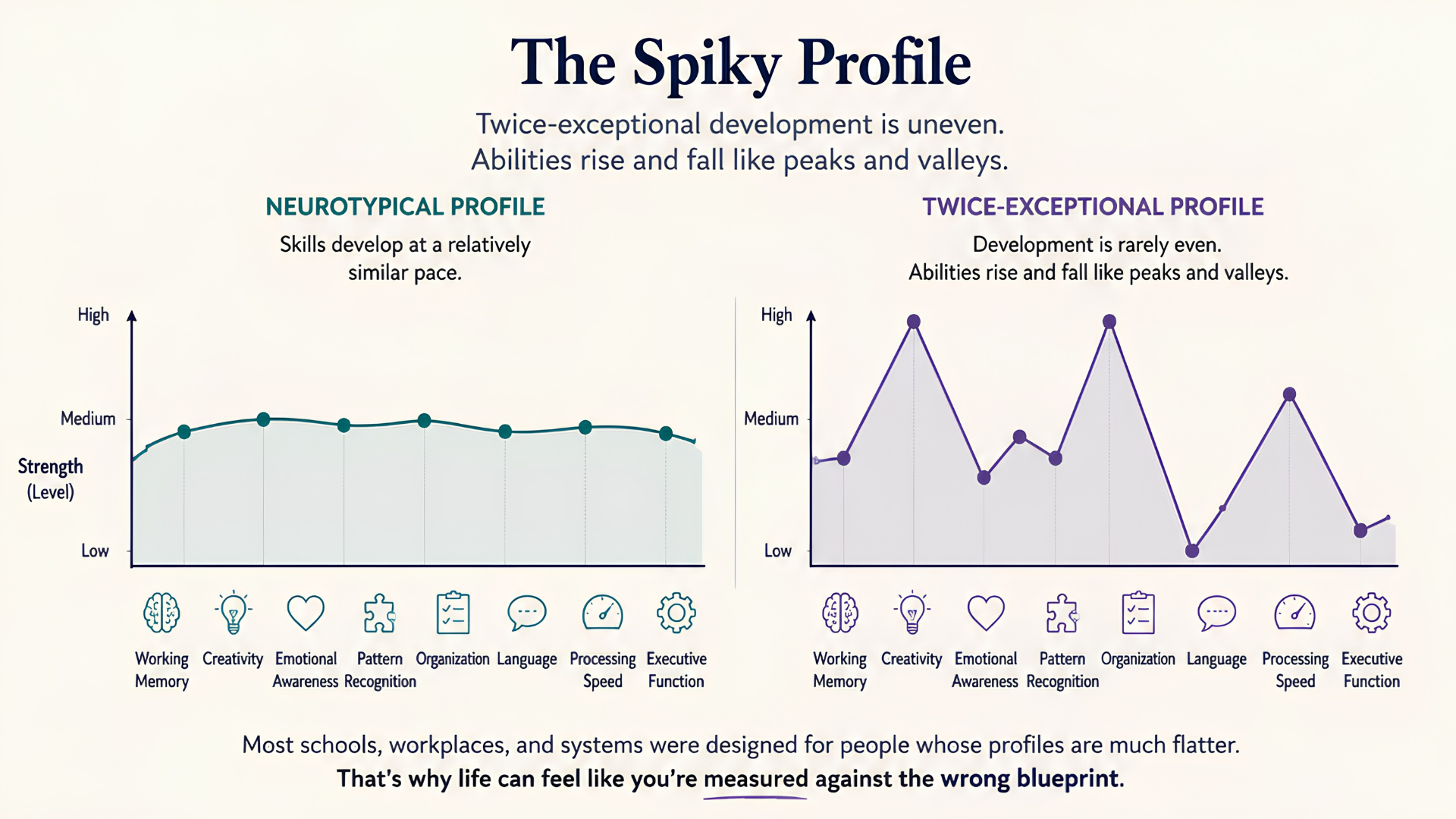
The spiky profile: Why your strengths and challenges can exist together
One of the most helpful ways to understand the twice-exceptional brain is through something called a spiky profile.
But first, we need to understand why that profile exists.
For many gifted and neurodivergent people, development is often asynchronous.
That means different abilities, skills, and areas of development don’t all progress at the same rate.
You may be years ahead in some areas while finding other areas much harder than expected.
Your intellectual ability might be incredibly advanced, while emotional regulation, organisation, communication, or everyday life skills require far more support.
This uneven development is what creates the spiky profile.
When psychologists look at cognitive assessments or psychoeducational evaluations, this pattern can sometimes appear visually: significant peaks in some areas and lower points in others.
Imagine plotting your strengths on a graph.
Some areas shoot off the page.
Others sit much lower.
Rather than a smooth line, your profile looks more like a mountain range.
This is your spiky profile.
And most schools, workplaces, and systems were designed for people whose profiles are much flatter.
That’s why life can sometimes feel as though you’re constantly being measured against the wrong blueprint.
A spiky profile means it’s entirely possible to be exceptionally gifted in one area while genuinely needing support in another.
For example, you might:
Lead complex strategy meetings with confidence, yet have no idea how to emotionally support your partner or teenager when they need you.
See connections and solutions that nobody else can see, yet lose your keys several times a day.
Write beautifully, yet struggle to complete paperwork.
Remember intricate details about your favourite subject, yet forget to eat lunch.
Be deeply empathetic towards others, yet find it difficult to identify what you’re feeling yourself.
To someone looking from the outside, these differences can seem confusing.
Sometimes they’re interpreted as inconsistency, laziness, or a lack of motivation.
But this isn’t inconsistency.
It’s asynchronous development.
It’s how the twice-exceptional brain is wired.
Your greatest strengths and your greatest challenges can exist side by side. Neither one cancels out the other.
“Your greatest strengths and your greatest challenges can exist side by side. Neither one cancels out the other.”
When your nervous system has the volume turned up
Imagine your nervous system is like a radio.
For most people, the volume is set somewhere in the middle. They notice what’s important, filter out the rest, and move through the day without consciously processing every detail around them.
Now imagine the volume is turned up.
Not just a little.
Much louder.
Suddenly you notice everything.
The fluorescent lights buzzing in the office.
The label scratching the back of your neck.
The person across the room whose smile doesn’t quite reach their eyes.
The conversation happening behind you while you’re trying to concentrate.
The emotion in someone’s voice before they’ve even said what’s wrong.
The idea that arrives in your mind and immediately branches into ten more.
This is often what living with a twice-exceptional nervous system feels like.
You’re not simply taking in more information.
You’re processing more of it, more deeply, and often all at once.
That heightened awareness can become one of your greatest strengths.
It’s often why gifted and neurodivergent people notice patterns others miss, solve complex problems creatively, and connect ideas in ways that seem almost effortless.
But there’s another side to it.
If your nervous system is constantly taking in more information than average, it also has more information to organise, filter, interpret and respond to.
That takes energy.
A lot of energy.
Which is why many twice-exceptional adults reach the end of the day completely exhausted - even when it doesn’t look as though they’ve “done” very much.
Their brain has been working all day.
People often assume giftedness means having “more brain power.”
In many ways it does.
But it also means your brain is often running far more processes in the background than anyone else can see.

When everything feels more intense
Psychologist Kazimierz Dabrowski described something he called overexcitabilities (OE’s for short).
Despite the name, this doesn’t mean being overly dramatic or overreacting.
It simply describes a nervous system that responds to the world with greater intensity.
You don’t just notice life.
You experience it deeply.
For some people, that’s emotional.
A passing comment can stay with you for days.
You don’t just feel disappointment.
You replay it.
You think about what was said, what wasn’t said, what it meant, what you should have said differently.
Joy works the same way.
Wonder.
Beauty.
Love.
You don’t skim across the surface of emotions.
You dive straight into the deep end.
For others, the intensity is intellectual.
One question leads to twenty more.
A single conversation sends you down a rabbit hole of research.
Curiosity doesn’t switch off because your brain is constantly looking for patterns, meaning and understanding.
Many gifted adults describe having dozens of browser tabs open - not because they’re disorganised, but because every idea connects to another.
Then there is imaginative intensity.
You don’t just imagine possibilities.
You build entire worlds in your mind.
You rehearse conversations.
Visualise outcomes.
Think through every scenario before anything has even happened.
Sometimes this creativity is exhilarating.
Sometimes it’s exhausting.
Your body can experience intensity too.
You might find yourself constantly moving.
Tapping your foot.
Pacing while thinking.
Needing to walk during phone calls.
Not because you’re restless.
Because movement helps your nervous system process information.
And then there is sensory intensity.
You notice sounds, smells, textures, temperatures and visual details that other people barely register.
The tag in your T-shirt.
The hum of a refrigerator.
The flicker of a fluorescent light.
A perfume that everyone else says they can barely smell.
It isn’t that you’re being difficult.
Your nervous system has simply turned the volume up.
Once you understand this, many experiences that once felt confusing begin to make sense.
Sensory seeking and sensory avoidance
One of the biggest misconceptions about neurodivergence is that people are either “sensory sensitive” or they’re not.
In reality, many twice-exceptional people are both sensory seekers and sensory avoiders.
Sometimes within the same day.
You might crave movement because it helps your brain organise itself.
You may think more clearly while walking than sitting still.
You may play the same song on repeat because it helps your nervous system settle.
You might find yourself reaching for heavy blankets, hot baths, swimming, gardening, woodworking, knitting, baking, or lifting weights - not simply because you enjoy them, but because they give your nervous system the input it needs.
Or you may notice that certain environments seem to regulate you.
Being near the sea or bodies of water.
Walking in nature.
Watching the movement of trees.
Feeling grounded by fresh air and open spaces.
Spending time with animals.
The calm presence of a dog.
The comfort of a cat curled beside you.
Or even the opposite - feeling energised by the movement, colour, sounds, and stimulation of a vibrant city.
Because regulation looks different for every nervous system.
One person’s overwhelm can be another person’s calm.
Many gifted and neurodivergent people discover these sensory supports long before they understand why they need them.
They simply know:
“I feel better when I’m there.”
“I can think more clearly when I do this.”
“I feel more like myself in that environment.”
Equally, there are experiences your nervous system may work hard to avoid.
Busy shopping centres.
Bright lighting.
Multiple conversations happening at once.
Scratchy fabrics.
Unexpected loud noises.
Strong smells.
It’s not that you’re being difficult or fussy.
Your brain is already processing an extraordinary amount of information.
Adding more of the wrong kind of input can simply become too much.
Parents often notice this in gifted and neurodivergent children before they recognise it in themselves.
A child who refuses certain clothes.
Who becomes distressed in noisy environments.
Who chews sleeves, spins, climbs, jumps, or rocks.
Who needs quiet after school before they can talk.
Who seeks deep pressure, movement, or certain textures.
These behaviours are often viewed as problems to stop.
But when we understand the nervous system, we see something different.
We see a child trying to regulate.
The behaviour isn’t random.
It’s purposeful.
The same is true for adults.
Perhaps you always choose the same café because it feels calm.
Perhaps you wear the same comfortable clothes every week.
Perhaps you always sit in the same seat during meetings.
Perhaps you need silence after a busy day before you can have a conversation.
Perhaps you instinctively seek water, nature, animals, movement, music, creativity, or certain spaces because they help bring your system back into balance.
These aren’t quirks.
They’re adaptations.
Your nervous system has quietly been learning what helps it feel safe, focused, and regulated.
Interoception: Listening to the quiet signals
Most of us are taught to pay attention to what’s happening around us.
Far fewer of us are taught to notice what’s happening inside us.
This ability is called interoception.
It’s your brain’s ability to recognise the signals coming from your own body.
Am I hungry?
Am I thirsty?
Am I tired?
Am I anxious?
Do I need a break?
For many twice-exceptional people, those signals can be surprisingly quiet.
Or they arrive late.
You might suddenly realise you haven’t eaten all day.
You stand up from your desk and notice your shoulders have been tense for hours.
You become snappy with someone you love before realising you’re actually overwhelmed.
You push through exhaustion because your brain is still interested - even though your body has been asking you to stop for some time.
This isn’t because you’re ignoring your body.
It’s because your attention has been pulled somewhere else.
Many gifted and neurodivergent people become so absorbed in the outside world - or in their own thinking - that the body’s quieter signals struggle to compete.
Over time, this can contribute to burnout.
Not because you don’t care for yourself.
But because your nervous system doesn’t always communicate its needs in ways that are easy to hear.
Learning to strengthen interoception is one of the kindest things you can do for yourself.
Sometimes it starts with something incredibly simple.
Pausing for a moment and asking:
“What is my body trying to tell me right now?”
Not what your mind is saying.
Your body.
Because the body often notices long before the mind catches up.

Alexithymia: When your body knows before your mind does
One of the most misunderstood experiences for many twice-exceptional people is something called alexithymia.
Despite what the name suggests, alexithymia doesn’t mean you don’t have emotions.
Quite the opposite.
It often means you feel emotions deeply - but struggle to identify, describe, or put words to what you’re experiencing.
Imagine your emotions are speaking one language and your thinking brain is speaking another.
The message is there.
It just takes longer to translate.
You might notice your heart racing before you realise you’re anxious.
You might become irritable before recognising you’re overwhelmed.
You might suddenly burst into tears, only to realise later that you’d been carrying sadness for days.
It isn’t that your emotions aren’t there.
It’s that your brain and body sometimes need more time to agree on what those emotions actually are.
For gifted and neurodivergent adults, this can be particularly confusing.
You’re often highly intelligent.
Highly reflective.
Excellent at analysing other people’s experiences.
Yet when someone asks,
“How are you feeling?”
Your mind goes blank.
Or you answer with thoughts rather than feelings.
“I’m just tired.”
“I’m fine.”
“I’ve got a lot going on.”
Over time, this disconnect can make it harder to notice stress until your nervous system has already reached its limit.
Learning the language of your own body isn’t about becoming more emotional.
It’s about becoming more connected to yourself.
Executive function: Why knowing isn’t the same as doing
One of the most frustrating parts of being twice-exceptional is knowing exactly what needs to happen…
…and still feeling unable to begin.
This is where many people start criticising themselves.
“Why can’t I just do it?”
“Everyone else seems to manage.”
“I’m so capable at work - why can’t I organise my kitchen?”
The answer often lies in executive function challenges (sometimes called executive dysfunction).
Executive function is the brain’s management system.
It’s responsible for skills like:
getting started
planning
prioritising
switching between tasks
organising information
remembering what you’re doing
managing time
following through
These skills are often invisible to people who don’t struggle with them.
They happen automatically.
For many twice-exceptional adults, they don’t.
Every step requires conscious effort.
That’s why everyday tasks can sometimes feel surprisingly exhausting.
Writing the email.
Making the phone call.
Booking the appointment.
Putting the washing away.
None of these tasks are intellectually difficult.
They’re neurologically demanding.
Understanding this changes everything.
Because the problem isn’t intelligence.
It’s bandwidth.

Why decision fatigue happens so easily
Every decision your brain makes costs energy.
This is one of the reasons ADHD decision fatigue is such a common experience for many gifted and neurodivergent adults.
For many people, those costs are relatively small.
For a twice-exceptional nervous system that’s already processing huge amounts of information, those costs add up much more quickly.
This is why many gifted and neurodivergent adults find themselves exhausted by decisions that other people barely notice.
What should I wear?
What’s for dinner?
Which email should I reply to first?
Should I start with the washing or the shopping?
Individually, they’re tiny.
Collectively, they’re relentless.
By the end of the day, your nervous system may simply have nothing left to give.
This is one of the reasons routines can feel so comforting.
Not because you’re rigid.
Because they remove unnecessary decisions.
Steve Jobs famously wore the same outfit almost every day.
Barack Obama spoke about limiting his clothing choices because he wanted to preserve his mental energy for decisions that really mattered.
Many of my clients naturally create similar rhythms.
Friday night is always curry night.
Breakfast rarely changes.
They rotate the same trusted outfits.
Not because they’ve given up on spontaneity.
Because they’re protecting the finite cognitive energy their nervous system has available.
This isn’t laziness.
It’s intelligent energy management.
(If decision fatigue is something you experience regularly, I’ve written more about it in my blog, Decision Fatigue: Why Simplicity Is Not Laziness.)
The burnout that nobody sees
When people hear the word burnout, they often picture someone working eighty-hour weeks.
But twice-exceptional burnout is often much quieter.
It builds over years.
Years of masking.
Years of adapting.
Years of compensating for challenges that nobody else can see.
Years of pushing through sensory overwhelm.
Years of analysing every social interaction.
Years of trying to live as though your nervous system works like everyone else’s.
Eventually, something has to give.
Many people describe it as though the volume has become too loud to ignore.
Things that once felt manageable suddenly don’t.
Simple tasks become overwhelming.
Decision-making slows.
Emotions feel closer to the surface.
Recovery takes longer.
You may withdraw socially because interacting with people feels too demanding.
You might question your abilities.
Wonder if you’ve become lazy.
Or worry that you’ve somehow “lost” your intelligence.
You haven’t.
Your nervous system has simply been carrying too much for too long.
Burnout isn’t a sign of failure.
It’s information.
It’s your nervous system saying:
“I can’t keep running at this pace without enough recovery.”
The goal isn’t to become less sensitive
This is perhaps the biggest misconception I encounter.
People often come to coaching having been conditioned by others to believe THEY need to change. To become:
Less emotional.
Less sensitive.
Less intense.
Less affected by the world around them.
But that’s not the goal.
Your sensitivity isn’t the problem.
Your depth isn’t the problem.
Your curiosity isn’t the problem.
Those qualities are also where your greatest strengths live.
The goal isn’t to turn the volume down until you become someone else.
It’s to recognise when your nervous system needs the volume lowered, when it needs more recovery, and how to create an environment where it doesn’t have to work so hard simply to get through the day.
Because once you understand your wiring, you can support it before overwhelm turns into burnout.
Because once you stop fighting your wiring…
You can start working with it.
And that’s where life begins to feel very different.
Building your user manual
For much of your life, you may have been trying to operate from someone else’s instructions.
Trying harder.
Being more organised.
Pushing through.
Masking.
Comparing yourself to people whose nervous systems process the world very differently.
It’s exhausting.
And it’s one of the biggest reasons so many twice-exceptional adults end up feeling as though they’re constantly failing at things that “should” be easy.
But what if you were never using the right manual?
What if your brain doesn’t need fixing?
What if it simply needs understanding?
That’s what I mean when I talk about creating your own user manual.
A user manual isn’t about changing who you are.
It’s about learning how your nervous system works so you can build a life that works with it instead of constantly fighting against it.
For example, your user manual might include things like:
My nervous system works best when…
I have quiet time before and after social events.
I eat before I become hangry.
I keep routines simple rather than constantly chasing novelty.
I break large tasks into much smaller steps.
I write things down instead of relying on working memory.
I have movement throughout the day.
I give myself permission to recover after periods of intense focus.
I choose environments that reduce unnecessary sensory input.
I stop expecting myself to function the same way every single day.
None of these are signs of weakness.
They’re examples of self-understanding.
And self-understanding is far more powerful than self-criticism.
Working with your wiring
One of the biggest shifts I see in coaching doesn’t happen because someone suddenly becomes more productive.
It happens because they stop measuring themselves against a blueprint that was never designed for them.
They stop asking:
“Why can’t I just be more disciplined?”
And start asking:
“What does my nervous system need right now?”
That one question changes everything.
Because your nervous system isn’t trying to make life difficult.
It’s trying to keep you safe.
The more you understand its patterns, the less you need to fight them.
Working with your wiring doesn’t mean lowering your ambitions.
It doesn’t mean doing less.
It means using your energy differently.
Protecting it where it leaks.
Investing it where your gifts shine.
Building a life around how your nervous system actually works, rather than constantly asking it to become somebody else’s.
For parents reading this
If you’re recognising your child in these descriptions, you may also be recognising yourself.
That happens more often than you might think.
Many parents first come to me because they’re worried about their child.
Only to realise, somewhere during our conversations, that they’ve spent decades living with the same nervous system.
Perhaps you’ve always been the child who was “too sensitive.”
The one who asked endless questions.
The one who struggled to fit into systems that never quite made sense.
Now you’re watching your child have a similar experience.
That can feel overwhelming.
But it can also be incredibly healing.
Because when you understand your own wiring, you become much better equipped to understand theirs.
And when a child feels understood, everything begins to change.
Understanding comes before change
There’s a temptation - especially for gifted people - to finish an article like this and immediately ask:
“What should I fix first?”
I understand that instinct.
Gifted minds love solving problems.
But before you try to change anything…
Pause.
Just notice.
Notice where you recognised yourself.
Notice the parts that brought relief.
Notice the places where you’ve been holding yourself to impossible standards.
Awareness is never the final destination.
But it is always the first step.
Because we can’t support a nervous system we don’t yet understand.
If this resonates…
If you’ve found yourself nodding while reading this, please know you’re not alone.
Whether you’re recognising yourself for the first time, making sense of your child’s behaviour, or finally finding language for experiences you’ve carried for years, something important has already begun.
Understanding.
And understanding has a way of changing everything.
This is the work I do every day with gifted and neurodivergent adults, parents, and families.
Together, we explore how your nervous system works, why life has felt the way it has, and what changes can help you build a life that’s more sustainable, more compassionate, and more aligned with who you really are.
If you’d like to explore what that could look like for you, I’d love to invite you to book a free consultation.
It’s simply a chance to talk, ask questions, and see whether coaching feels like the right next step.
No pressure.
No expectations.
Just a conversation.
Frequently asked questions
-
Twice-exceptional (2e) describes someone who is both gifted and neurodivergent. This might include giftedness alongside ADHD, autism, dyslexia, dyspraxia, dyscalculia, or another neurodivergence. A 2e person often has exceptional strengths alongside genuine challenges, creating what’s known as a spiky profile.
-
Yes. Giftedness and neurodivergence frequently occur together. In fact, many twice-exceptional adults go unrecognised because their giftedness masks their neurodivergence, or their neurodivergence masks their giftedness.
-
A spiky profile describes uneven development across different areas of ability. A twice-exceptional person may excel in problem-solving, creativity, or pattern recognition while simultaneously finding executive functioning, organisation, emotional regulation, or sensory processing much more challenging.
-
Many gifted adults experience executive functioning differences, sensory processing differences, and heightened nervous system activity. Everyday tasks often require far more cognitive energy than people realise, particularly when combined with masking, decision fatigue, or burnout.
-
Overexcitabilities, first described by psychologist Kazimierz Dabrowski, refer to a heightened way of experiencing the world. They can show up emotionally, intellectually, imaginatively, physically, or through the senses, contributing to the depth and intensity often seen in gifted individuals.
-
Alexithymia is difficulty recognising, identifying, or describing your own emotions. It doesn’t mean you don’t have feelings - it means there can be a delay between what your body is experiencing and your ability to put those experiences into words.
-
Interoception is your ability to notice internal body signals such as hunger, thirst, fatigue, pain, or emotional activation. Many neurodivergent people have differences in interoception, making it harder to recognise their body’s needs until they become intense.
-
Absolutely. While understanding alone doesn’t remove every challenge, it reduces shame. Once you understand how your nervous system works, you can begin building routines, environments, and supports that work with your wiring rather than against it.
-
Because giftedness often masks neurodivergence, while neurodivergence can also mask giftedness. Many adults learn to compensate for challenges, meaning they appear highly capable on the outside while struggling internally. They often aren’t recognised until burnout, parenthood, or significant life changes bring those differences into sharper focus.
This is part of a monthly series on neurodivergence, burnout, and healing. Subscribe to the newsletter for stories and tools that meet you where you are.
