
Gifted code-switching: The hidden cost of masking your intelligence

If you grew up gifted, there’s a good chance you learned early how to adjust yourself depending on the room you were in.
Maybe you became quieter so people wouldn’t think you were “too intense.”
Maybe you filtered your vocabulary. Pretended not to know the answer. Held back your ideas until you knew it was safe.
Maybe you learned to laugh things off, play smaller, or become “easy-going” so you wouldn’t stand out too much.
Over time, it becomes automatic.
You learn how to read people quickly.
How to soften yourself.
How to stay relatable.
How to avoid making others uncomfortable with the depth, speed, or intensity of your mind.
In gifted spaces, this is often called gifted code-switching.
In neurodivergent spaces, it’s often called masking.
Different language. Similar survival strategy.
And for many gifted adults - especially gifted women and twice-exceptional (2e) individuals - it becomes exhausting.

What is gifted code-switching?
Gifted code-switching is the act of changing how you speak, behave, think, or express yourself in order to fit the environment around you.
It can look like:
Downplaying your intelligence
Hiding your intensity
Pretending not to care deeply
Avoiding “big” conversations
Editing your language depending on who you’re with
Acting less capable so other people feel more comfortable
Some gifted adults become so skilled at adapting that they don’t even realise they’re doing it anymore.
It becomes reflex.
And while gifted masking can help someone socially survive, it often comes at a cost:
chronic exhaustion, disconnection, anxiety, burnout, and the quiet feeling of never fully being yourself.

The chameleon effect: When adapting becomes automatic
For many gifted people, especially those who are also neurodivergent, code-switching eventually turns into something deeper.
You stop simply adjusting.
You start shape-shifting.
You mirror the humour in the room.
The energy.
The emotional tone.
The pace of conversation.
You become highly socially intelligent - but internally disconnected.
Sometimes you become so good at adapting that you stop knowing what’s genuinely you.
And because people often respond positively to the adapted version of you, the cycle reinforces itself.
You learn:
this version is safer.
this version is accepted.
this version belongs.
But underneath that adaptation is often a deep exhaustion.
Because constantly monitoring yourself takes energy.
And gifted people are often monitoring far more than anyone realises.

Why gifted people adapt so quickly
Many gifted adults have spent years wondering:
Why do I automatically scan the room?
Why do I notice every tiny shift in tone or energy?
Why do I adapt so quickly without even meaning to?
Part of the answer may lie in something called hyper-plasticity.
Gifted and neurodivergent brains are often highly responsive to environmental input. They pick up patterns quickly - not just in information, but in people.
You notice:
subtle rejection
discomfort
intimidation
changes in body language
emotional tension
And because the brain is wired to learn quickly, it also learns quickly what feels socially “safe.”
So many gifted children unconsciously begin editing themselves early:
speaking less
hiding interests
suppressing intensity
becoming more agreeable
acting less “different”
Not because something is wrong with them.
Because adaptation becomes survival.
Asynchronous development: Feeling “too old” and “too sensitive” at the same time
One of the most confusing parts of giftedness is something called asynchronous development.
This means different parts of you develop at different speeds.
You might:
intellectually understand complex ideas far beyond your age
but still feel emotionally overwhelmed very easily
think like an adult
while still needing reassurance or safety like a child
Many gifted children are described as:
“old souls,”
“wise beyond their years,”
or “emotionally intense.”
And many gifted adults grow up feeling strangely out of sync with everyone around them.
You may have felt:
intellectually ahead of peers
emotionally overwhelmed by the world
deeply aware of injustice, suffering, or complexity
lonely, even when surrounded by people
So when gifted people code-switch, they are often trying to smooth out this mismatch.
To make themselves more socially digestible.
To reduce the gap between what they perceive internally and what the environment can comfortably hold.
Gifted masking vs neurodivergent masking
There is a lot of overlap between gifted masking and neurodivergent masking - especially for twice-exceptional people.
But there can be subtle differences.
While there’s a lot of overlap between gifted masking and neurodivergent masking, the internal drivers can sometimes look slightly different:
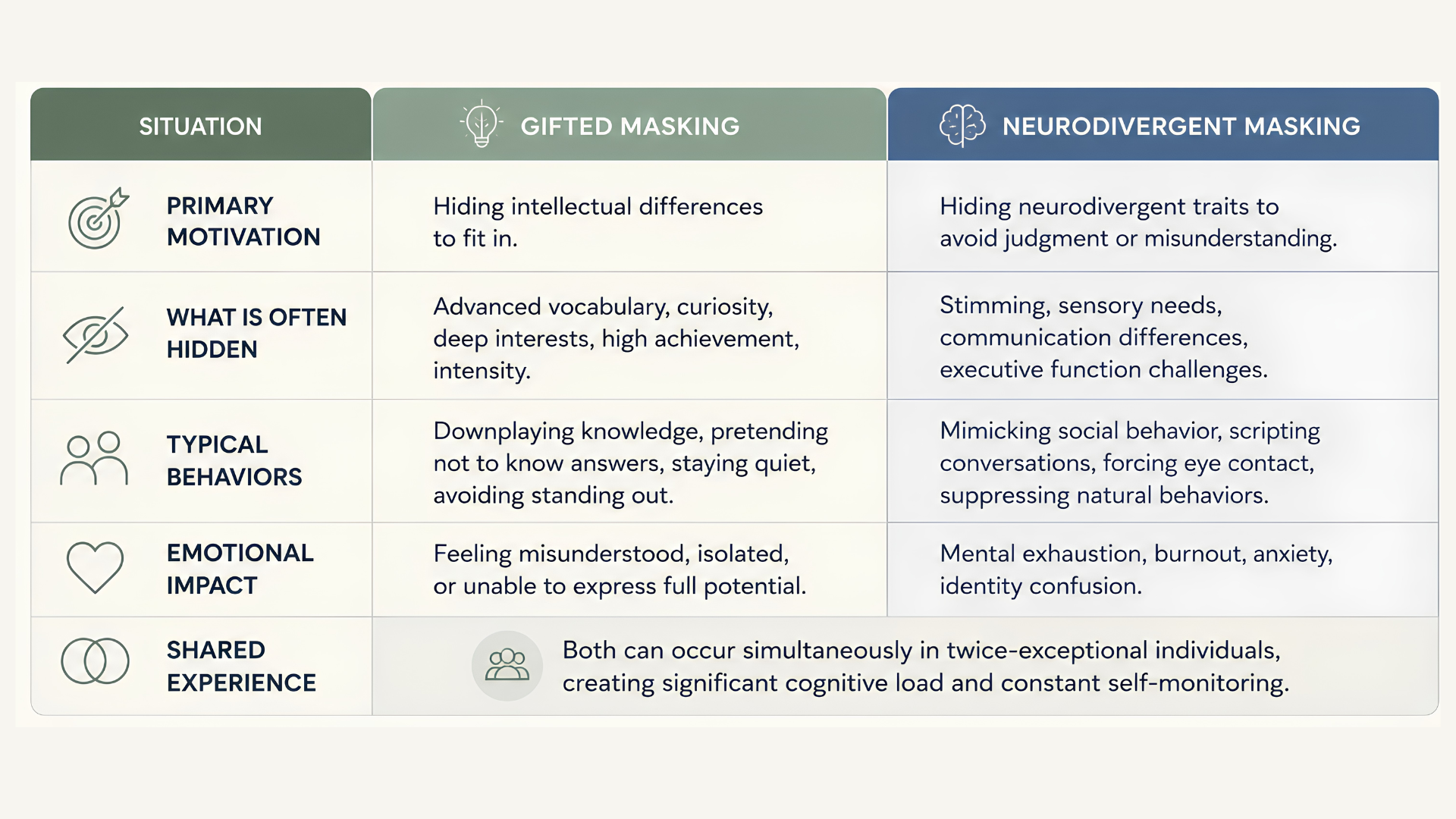
Many gifted and neurodivergent adults experience both simultaneously.
Which means the cognitive load becomes enormous.
You aren’t just existing naturally.
You’re constantly translating yourself.

Why so many gifted adults feel lonely
One of the quietest consequences of gifted masking is existential loneliness.
Not always physical relational loneliness - which is about a lack of people around you. This is solved by finding a community or friend group.
But the feeling that no one, or very few, truly know you deeply.
Relational loneliness says "I don't have anyone to sit with".
Existential loneliness says "I am sitting with people, but I am entirely alone in my experience of the universe".
Because when you spend years adapting yourself, many relationships become built around the version of you that feels safest - not the version that feels most authentic.
You may have:
hidden your intensity
edited your curiosity
softened your opinions
reduced your emotional depth
avoided talking about what genuinely fascinates you
And over time, connection can start to feel performative instead of nourishing.
This is why so many gifted adults say things like:
“I’ve always felt different.”
“I can connect with people, but rarely feel understood.”
“I feel lonelier in groups than when I'm on my own.”
The problem was never your depth or difference.
It was constantly having to reduce it.

The burnout beneath the mask
Gifted people often experience what psychologist Kazimierz Dabrowski called overexcitabilities (OE's for short) - heightened emotional, intellectual, sensory, imaginative, or physical intensity.
Which means many gifted adults don’t just think more deeply.
They feel more deeply too.
Thoughts feel louder.
Sensory input builds faster.
Curiosity doesn’t switch off.
Emotions move intensely through the body.
So when a gifted person spends all day masking or code-switching, they aren’t simply hiding behaviour.
They’re suppressing intensity.
And eventually, that creates burnout.
Not because they’re weak.
Because the nervous system was never designed to run a constant social simulation all day long.
Many gifted adults aren’t tired because they’re “doing too much.”
They’re tired because they’ve spent years trying to be less of themselves.
The real problem was never your mind
The issue was never your intelligence, your sensitivity, your intensity, or your depth.
The issue is that many environments reward compliance over complexity.
We live in systems that often misunderstand giftedness - especially when it doesn’t look polished, productive, or easy.
Gifted children are called:
“too sensitive,”
“dramatic,”
“intense,”
“difficult,”
or “too much.”
Gifted adults learn to self-edit in order to belong.
But constantly shrinking yourself creates its own kind of pain.
Because eventually, the nervous system starts asking:
When do I get to stop performing?
So what now?
If this resonates, you may be recognising years of adaptation that once helped you survive - but no longer feel sustainable.
And maybe this is the first time you’ve had language for it.
That matters.
Because once you understand gifted masking and code-switching, you stop seeing yourself as “too much” or socially flawed.
You begin to understand the intelligence behind the adaptation.
And from there, something new becomes possible:
not abandoning yourself to fit in,
but building relationships, environments, and rhythms where you no longer need to perform safety all the time.
If this resonates…
This is the work I do with gifted and neurodivergent adults.
Together, we explore:
gifted masking and burnout
nervous system regulation
emotional intensity
identity beneath adaptation
twice-exceptionality and giftedness
rebuilding a life that feels more honest and sustainable
If you’d like support understanding your wiring - or finally putting down the mask a little - you can book a free consultation with me here.
No pressure. Just a conversation.
Frequently asked questions
-
Gifted masking is when a gifted person hides or suppresses parts of themselves - such as intelligence, intensity, sensitivity, or curiosity - in order to fit in socially or avoid rejection.
-
Gifted code-switching is adapting how you speak, behave, or express yourself depending on the environment around you. Many gifted adults do this automatically after years of trying to avoid standing out.
-
Many gifted adults feel lonely because they spend years adapting themselves to fit other people’s expectations. This can create relationships where they feel liked, but not fully known or understood.
-
Asynchronous development means different areas of development happen at different speeds. A gifted child may be intellectually advanced while still emotionally sensitive or overwhelmed.
-
Yes. Many gifted people are also neurodivergent. This is often called twice-exceptionality (2e), where someone is both gifted and ADHD, autistic, dyslexic, or otherwise neurodivergent.
This is part of a monthly series on neurodivergence, burnout, and healing. Subscribe to the newsletter for stories and tools that meet you where you are.
