
Boreout in gifted adults: When your brain is exhausted from too little stimulation

There’s something we don’t talk about enough.
Sometimes exhaustion doesn’t come from doing too much.
Sometimes it comes from not having enough of what your brain actually needs.
We’re much more familiar with the idea of burnout: pushing for too long, giving too much, masking, compensating, and ignoring your needs until your nervous system finally says, “I can’t keep doing this.”
But for many gifted and neurodivergent adults, there is another experience that can look surprisingly similar.
Boreout.
And understanding the difference matters.
Because the thing that helps you recover from one can sometimes make the other worse.

What is boreout?
Boreout is what happens when your brain and nervous system are chronically under-stimulated.
For gifted and neurodivergent people, this is rarely about simply “being bored.”
It goes much deeper than that.
A gifted brain is designed to:
Explore.
Question.
Connect.
Create.
Solve.
Understand.
It naturally looks for patterns, possibilities, problems, and meaning.
So when that brain spends too long without enough challenge, curiosity, creativity, connection, or growth, it doesn’t simply switch off.
Sometimes it turns inward.
You might start:
overthinking everything
replaying conversations
searching for problems to solve
imagining worst-case scenarios
feeling flat, disconnected, or unmotivated
questioning yourself or your purpose
Not because something is wrong.
Because your brain is searching for something meaningful to engage with.
The same nervous system that gives you extraordinary insight can struggle deeply when it has nowhere meaningful to direct that energy.
And for many gifted people, this is where another layer appears.
You may have spent your whole life being able to see connections quickly.
You just know.
You see the pattern.
You reach the conclusion.
Sometimes long before you can explain every step you took to get there.
A bit like the child who is naturally gifted at maths and gives the correct answer instantly - but gets frustrated when asked to show every stage of their working.
Their brain has already made the leap.
Many gifted adults experience the world this way.
Your mind is built to connect, analyse, imagine, and understand.
So when that ability has nowhere meaningful to go, it doesn’t disappear.
It often turns inward.
Why boreout can feel like burnout
This is where it gets confusing, because boreout and burnout can look incredibly similar.
Both can create:
exhaustion
low motivation
difficulty starting things
feeling disconnected
withdrawing from people
losing interest in things you normally enjoy
So many gifted adults assume:
“I must be burnt out. I need to stop.”
And sometimes that’s true.
But sometimes something different is happening.
Your nervous system isn’t overloaded.
It’s underfed.

Burnout versus boreout: understanding the difference
Burnout often happens because you’ve spent too long exceeding your capacity.
You’ve been masking, over-giving, constantly adapting, ignoring your limits, or carrying responsibilities without enough recovery.
Your energy has been spent.
Your system needs:
rest
boundaries
recovery
protection from the things that keep draining you
Boreout is different.
With boreout, there is often energy there - but it has nowhere to go.
It can feel restless.
Like something inside you is searching.
You’re tired, but also strangely unsettled.
You don’t need more pressure.
But you do need the right kind of stimulation.
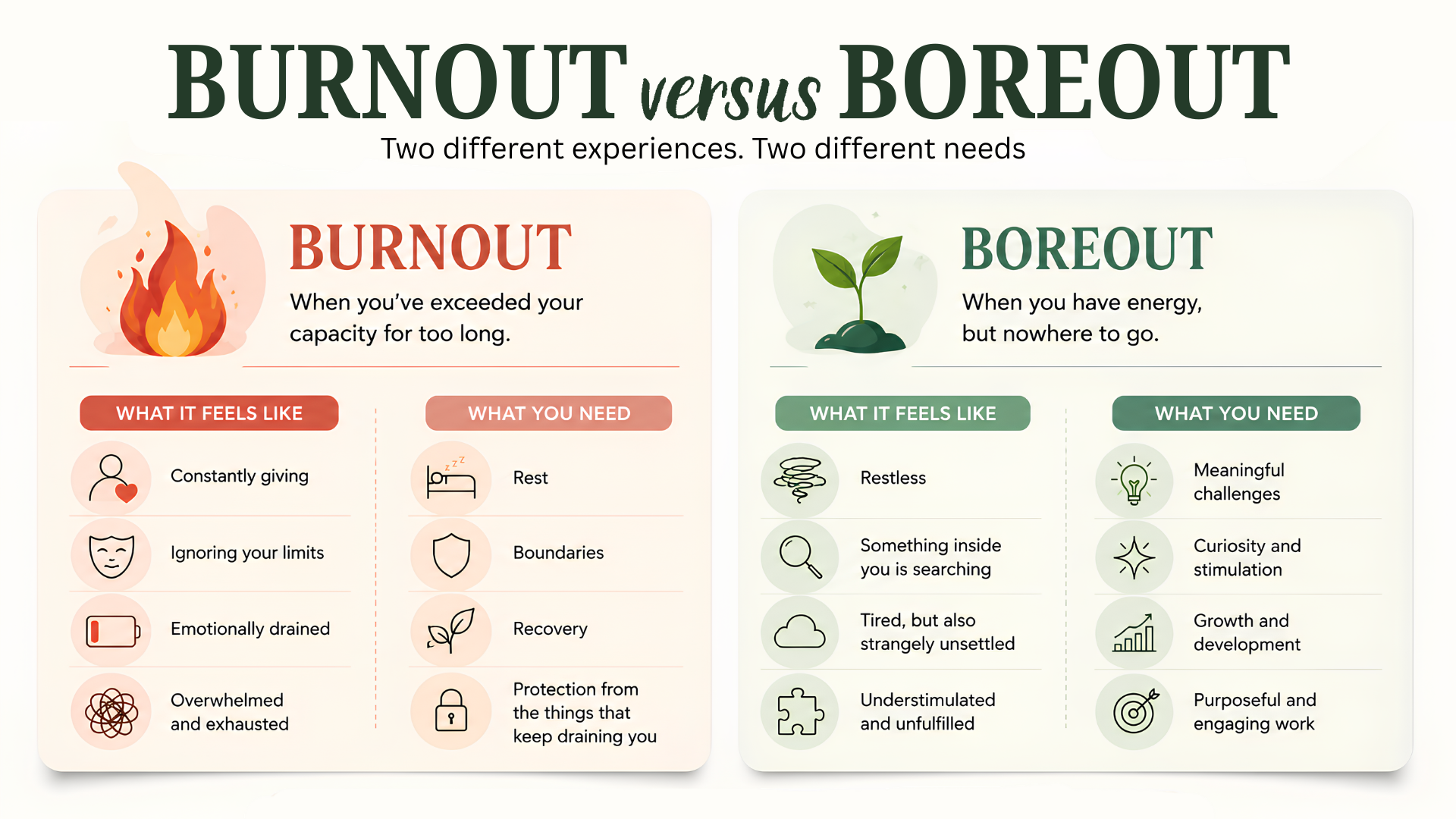
Understanding the difference matters because the support you need may look completely different.
“Burnout is the cost of exceeding your capacity for too long.
Boreout is the cost of ignoring your potential for too long.”

Why rest doesn’t always solve everything
This is one of the biggest misunderstandings.
When someone is exhausted, the obvious advice is:
“Just rest.”
And rest absolutely matters.
Especially after years of masking, pushing, or living in survival mode.
But some gifted and neurodivergent people notice something strange.
They finally stop.
They clear their schedule.
They remove every demand.
And somehow…
They feel worse.
More anxious.
More disconnected.
More stuck.
Because their nervous system still needs something to engage with.
For some people, endless rest becomes another form of deprivation.
Being bored takes energy too.
Your brain starts searching for stimulation.
And if it can’t find something meaningful externally, it may start creating stimulation internally.
More thinking.
More analysing.
More worrying.
The goal isn’t simply doing nothing.
The goal is finding the right level of challenge and stimulation your brain and nervous system can tolerate.
When boreout becomes something deeper
When boreout continues for a long time, it can start to feel like more than boredom.
For some gifted adults, chronic under-stimulation can contribute to existential depression - a deep sense of disconnection that comes from feeling separated from meaning, purpose, or who you really are.
Not just:
“I’m bored.”
But:
“What is the point of this?”
“Is this really what life is supposed to feel like?”
“Why do I feel so disconnected from things other people seem satisfied with?”
Because gifted minds often don’t just want activity.
They want meaning.
Depth.
Growth.
Purpose.
When there is a big gap between what you know you’re capable of and how you’re actually spending your time, it can become incredibly painful.
You might look around and think:
“I should be grateful. My life looks fine.”
But something inside you still feels like it’s slowly switching off.
That’s the difference between needing entertainment and needing alignment.
Boreout isn’t solved by filling your calendar with more things.
You can be busy and still be deeply under-stimulated.
Because your nervous system isn’t asking for more noise.
It’s asking for something that feels meaningful.

Finding your “just enough” challenge
A gifted nervous system often needs challenge.
But it needs the right challenge.
Too much:
Overwhelm.
Too little:
Boreout.
The sweet spot is somewhere in between.
Something that stretches you without pushing you into survival mode.
Something that creates curiosity without pressure.
Something that gives your brain somewhere meaningful to go.
This might look like:
learning a new skill
taking a short course
exploring a creative interest
playing music
making something with your hands
having deeper conversations
spending time with people who expand your thinking
volunteering your time and ideas to support a meaningful cause
For me, this explains why I naturally like to dip my toes into different things - whether that’s drum training, learning about wealth development, or attending workshops and retreats full of people interested in spiritual growth or personal development.
My brain isn’t looking for constant change.
It’s looking for growth.
And that distinction matters.
Why the environment matters
Sometimes boreout isn’t about what you’re doing.
It’s about what you’re surrounded by.
I’ve seen clients who technically have full lives.
They’re volunteering.
Joining groups.
Sitting on boards.
Doing everything they thought would help.
From the outside, they look engaged.
But internally, something still feels missing.
Because activity isn’t the same as stimulation.
And being surrounded by people isn’t the same as feeling connected.
You can have a packed calendar and still be intellectually, emotionally, or creatively starved.
The question becomes:
“What am I not getting here that my nervous system actually needs?”
Maybe it’s deeper conversations.
More creativity.
People who challenge your thinking.
A stronger sense of purpose.
A different type of contribution.
Maybe the environment doesn’t allow you to think, create, question, or explore in the way your brain naturally wants to.
Over time, that mismatch can become exhausting.
The right environment gives you energy.
The wrong one slowly drains it.

Recovering from boreout
If burnout recovery is often about reducing what drains you…
Boreout recovery is about slowly reintroducing what feeds you.
Not all at once.
Not with pressure.
Small amounts.
A little curiosity.
A little challenge.
A little creativity.
A little movement towards something that reminds you who you are.
Think of it as drip-feeding your nervous system.
Enough stimulation to wake it back up.
Not so much that it becomes overwhelmed.

The goal is balance
A gifted and neurodivergent nervous system often lives between two extremes.
Too much input:
Burnout.
Too little meaningful input:
Boreout.
The work is learning your own rhythm.
Your own capacity.
Your own needs.
Because your brain was never designed to sit unused.
But it also wasn’t designed to run endlessly without recovery.
It needs both.
Rest and stimulation.
Stillness and challenge.
Recovery and growth.
And when you understand that, you stop asking:
“Why can’t I just be happy doing less?”
And start asking:
“What does my nervous system actually need right now?”
And sometimes the answer isn’t:
“I need to do less.”
Sometimes it’s:
“I need something that finally meets me where I am.”
If this resonates…
If you recognise yourself in this - constantly moving between exhaustion and craving more - you’re not alone.
Many gifted and neurodivergent adults spend years trying to choose between slowing down and pushing harder.
But the answer is often understanding your unique nervous system.
This is the work I do with gifted and neurodivergent adults: helping you understand your patterns, your needs, and how to build a life that supports your energy rather than constantly fighting against it.
Frequently asked questions
-
Boreout is a state of exhaustion caused by chronic under-stimulation, lack of challenge, or lack of meaningful engagement. For gifted and neurodivergent adults, it can happen when their need for creativity, learning, problem-solving, or purpose is unmet.
-
Yes. Gifted adults often have a strong need for depth, challenge, curiosity, and growth. When those needs are unmet for long periods, they may experience exhaustion, low motivation, restlessness, or a sense of disconnection.
-
No. They can look similar, but they often come from different places. Burnout usually comes from prolonged overextension, while boreout comes from prolonged under-stimulation.
-
Recovering from boreout often involves slowly adding meaningful stimulation back into your life through learning, creativity, connection, challenge, or environments that better match how your brain works.
This is part of a monthly series on neurodivergence, burnout, trauma and healing. Subscribe to the newsletter for stories and tools that meet you where you are.
