Understanding the Six Human Needs: Why We Do What We Do
Have you ever found yourself asking, “Why do I keep doing this?”
Or wondering why your partner clings to routine, your child lashes out without warning, or you keep reaching for that same habit - even though you know it’s not helping?
More often than not, the answer lies beneath the behaviour.
It’s not about willpower or logic. It’s about needs.
Not surface-level wants or preferences - but the core human needs that quietly drive everything we do. These are the unseen forces shaping our decisions, our habits, our relationships.
The Six Human Needs is a psychological framework introduced by Tony Robbins that completely changed how I support my clients - and how I understand myself, too. When you start to recognise these needs, the puzzle pieces begin to fit. What once seemed irrational or frustrating suddenly makes sense.
And that’s where real change begins.
Because once you understand the need behind the behaviour, you can choose new, healthier ways to meet that need - for yourself and for the people you love.
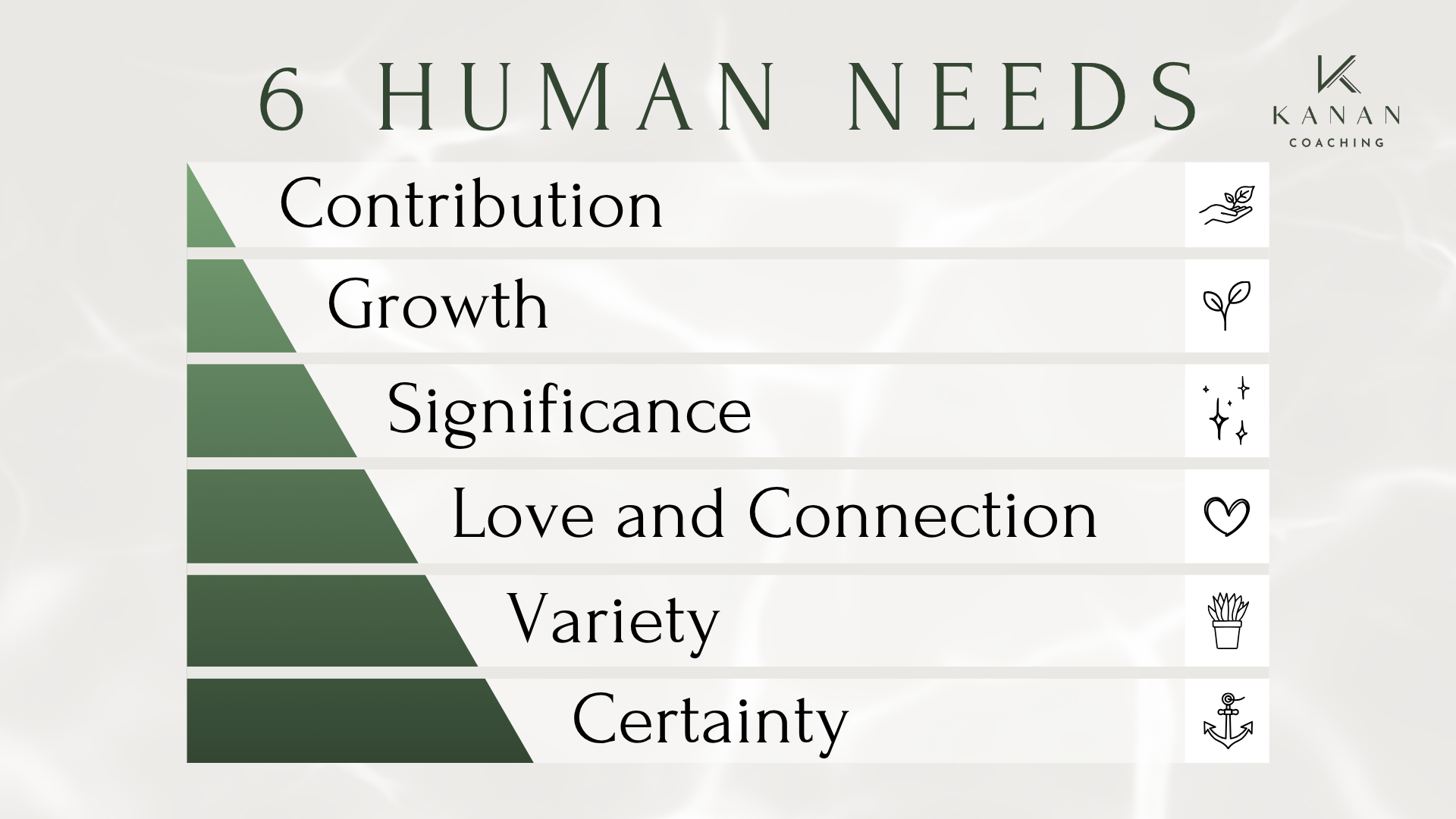
The Six Human Needs: A quick overview
Before we talk about behaviour change, compassion, or communication, we need to start here: every human being is driven by the same six needs.
They’re universal. They’re constant. And they explain far more than most people realise.
What differs from person to person is how we meet those needs and which ones we prioritise.
Some people build their whole lives around routine and safety.
Others chase stimulation, growth, or deep connection.
Some try to meet their needs in healthy, sustainable ways - and others reach for whatever brings relief fastest.
When you begin to understand these six needs, patterns become clearer:
why your child melts down,
why your partner shuts down,
why you cling to certain habits or relationships,
and why some behaviours feel impossible to “just stop.”
These needs aren’t random. They’re a blueprint for understanding human behaviour - and when you work with them instead of against them, everything becomes easier to navigate.
1. Certainty
Certainty is the need for safety, stability, and predictability.
It’s the part of us that says, “Please don’t surprise me today - I just need to know I’m okay.”
For some people, certainty looks like the practical things:
a stable job, a predictable routine, the same meal every Thursday, a familiar route home.
For others, it shows up in small comforts - a favourite blanket, the same TV show before bed, a bedroom that feels like a sanctuary.
Certainty isn’t just a preference. It’s the nervous system’s need to feel safe.
When life feels chaotic or overwhelming, certainty acts as the anchor. It helps us regulate, settle, and return to ourselves.
And when someone has a high need for certainty - especially if they’re neurodivergent, sensitive, or easily overstimulated - it’s not stubbornness or rigidity.
It’s their way of saying, “I need the world to feel predictable enough for me to function.”
Understanding this shifts everything.
Instead of seeing “routine” as inflexibility, you begin to see it for what it is: a stabilising force.
2. Variety (Uncertainty)
While certainty keeps us grounded, too much of it can leave us feeling stuck, flat, or restless. That’s where variety comes in - the need for novelty, stimulation, surprise.
This is the part of us that says, “I need something different today.”
For some, variety looks like travel, new experiences, or adventurous decisions - think spontaneous weekends away, trying an unusual dish, or even signing up for a course just because it sounds exciting.
For others, it’s subtle: switching up your route to work, listening to a new playlist, or simply changing the furniture around.
Variety helps us feel alive.
It’s what keeps energy moving, ideas flowing, and emotions from getting stagnant.
Especially for gifted or neurodivergent minds, novelty isn’t just fun - it can be deeply regulating. It feeds curiosity, creativity, and engagement.
Without enough variety, people can feel stuck in autopilot - bored, numb, or even rebellious.
Sometimes what looks like “self-sabotage” is actually someone trying to shake up a routine that’s become too safe.
So when someone craves change, it’s not always chaos - it might be their nervous system’s way of saying, “I need more colour here.”
3. Love and Connection
At our core, we all want to feel seen, valued, and held in belonging. That’s what the need for love and connection is about.
It’s not just about romantic love. This need can be met through friendship, community, spiritual connection, shared purpose - even a sense of closeness in professional spaces. Whether it’s a warm hug, a deep conversation, or knowing someone remembers your coffee order - these small moments build the invisible web that keeps us emotionally grounded.
When this need goes unmet, it doesn’t just feel lonely. It can feel like something vital is missing.
Because we’re not wired to go it alone - we’re wired for relationship.
People will go to incredible lengths to feel connected. They’ll join clubs, stay in difficult relationships, even adopt behaviours they don’t like - just to avoid the ache of isolation.
For some, connection shows up quietly - through shared routine, through eye contact, through simply being with someone without needing to perform. For others, it’s loud and expressive - words, touch, acts of service.
This need is often at the heart of conflict, especially in families or partnerships. When someone lashes out or shuts down, it’s often a signal: I don’t feel safe enough to connect.
For gifted or neurodivergent people, this need can feel particularly tender. You may have felt different for so long that genuine connection feels rare or risky. But that need hasn’t gone away - it’s just been waiting for a place it can land.
When we feel connected, we soften. We regulate. We heal.
4. Significance
We all have a deep, human need to feel important, valued, and distinct. Significance is the desire to know that we matter - that who we are and what we do makes a meaningful difference.
For some, it shows up as achievement, leadership, or recognition. For others, it’s quieter: being the reliable one, the fixer, the person others turn to in a crisis. It can be expressed through service, creativity, intellect, or even gentle rebellion - anything that allows us to feel seen in our uniqueness.
But significance doesn’t always appear in obvious or healthy ways.
Sometimes it shows up in forms we don’t immediately recognise.
We can feel significant by being the best at something - but also by being the worst.
For some people, this need is met through suffering, as though their pain must be the biggest in the room. You may have heard phrases like:
“I’m the most depressed person I know.”
“No one has it as bad as I do.”
This isn’t manipulation.
It’s a human need trying urgently to be met.
When someone feels invisible or misunderstood, even being the “most unwell” can create a sense of importance. People pay attention. They move closer. The pain becomes a vehicle for connection, validation, significance.
And this is not about blame - it’s about compassion.
When we understand that significance can be met through both healthy and unhealthy channels, we stop judging the behaviour and start seeing the need underneath it. From there, we can support ourselves - and others - in finding healthier, more sustainable ways to feel valued, respected, and seen.
When this need isn’t met, it can feel like fading into the background of your own life. That can trigger behaviours that look like arrogance, withdrawal, perfectionism, or people‑pleasing - anything to create a sense of worth again.
For gifted or neurodivergent individuals, significance can become deeply tangled in overachievement. You may have been praised for your performance but not truly seen for your humanity. Or perhaps your difference made you feel “too much” or “not enough,” so you learned to earn your place by being indispensable.
Significance isn’t ego.
It’s identity.
When met in a healthy way, it grounds us. It allows us to speak up, to share our voice, and to feel worthy of occupying space in the world.
These first four needs - certainty, variety, love and connection, and significance - are known as the needs of the personality. They’re foundational. These are the needs that shape how we move through the world, how we relate, how we cope. Whether it’s the need to feel safe, to feel special, or simply to belong, these are the drivers behind most of our daily choices and habits.
They are essential for survival. If even one of them is unmet, we’ll find ways - conscious or unconscious - to get it met, even if those ways aren’t always helpful or healthy.
But beyond survival, we’re wired for something more. Something deeper.
That’s where the final two human needs come in - the needs of the spirit. These are not about getting through the day; they’re about growing into who you really are. They’re about thriving, not just surviving.
Let’s look at those now.
5. Growth
We are wired to evolve. If we’re not growing, we’re stagnating.
Growth isn’t just about learning new skills or climbing a career ladder - though it can include those. It might look like expanding your emotional range, healing an old pattern, strengthening your boundaries, or nurturing a relationship that challenges you to show up more fully.
For some, growth shows up in podcasts and books. For others, it’s in therapy, coaching, or journaling. It could mean taking a creative risk, starting something new, or simply allowing yourself to feel more deeply than before.
Your nervous system needs stretch - but the right kind of stretch. Growth is what pulls you forward. It’s what gives life a sense of movement, purpose, possibility.
And when your need for growth isn’t being met? You may feel stuck, flat, even resentful - because part of you knows you’re built for more.
6. Contribution
We all want to matter beyond ourselves.
Contribution is the need to give, to add value, to leave a mark - whether quietly or boldly. It’s the part of us that lights up when we help someone, when we share what we’ve learned, when we feel like our presence makes a difference.
It might show up in mentoring, parenting, volunteering, creating, listening deeply, or simply showing up for someone when it counts. It doesn’t have to be grand - it just has to be real.
When your need for contribution is met, you feel purposeful, connected, part of something bigger. When it’s not, you might feel adrift, hollow, or overly focused on yourself - because giving, in healthy ways, is a vital nutrient for the soul.
And here’s the beautiful thing: contribution is often what heals us, too. When we give from a place of alignment - not obligation - it restores a sense of belonging in the world.
Needs drive behaviour: but we choose the vehicle
Here’s the heart of it: every behaviour is an attempt to meet a need. When someone lashes out, isolates, overcommits, or clings - it’s not random. It’s their nervous system reaching for something it needs. The question isn’t “what’s wrong with them?” but “what need are they trying to meet - and how?”
This is where the concept of vehicles comes in.
A vehicle is simply the method or behaviour we use to meet a core human need.
Take alcohol, for example. It’s not just a drink. For many, it becomes a go-to vehicle that meets multiple needs at once:
Certainty: “I know I’ll feel calmer after a drink.”
Variety: “It shifts my mood. It’s a break from the stress.”
Connection: “It helps me loosen up around people.”
When a single behaviour meets three or more needs at the same time, it becomes emotionally bonded. Not necessarily a clinical addiction, but a deep attachment. Even when we know it’s not good for us, we keep reaching for it - because it works. At least for a while.
But here’s the catch: not all vehicles are created equal.
Low-quality vehicles meet the need temporarily but often cause long-term harm. Think alcohol, overeating, toxic relationships, compulsive scrolling, overworking, people-pleasing. They offer relief - but it doesn’t last. And the cost adds up.
High-quality vehicles meet the same need in sustainable, life-giving ways. Think: movement, creative expression, therapy, play, safe connection, purpose-driven work. These vehicles regulate rather than numb. They nourish rather than deplete.
The goal isn’t to shame the behaviour or deny the need. The need is valid.
What matters is choosing a better vehicle - one that honours the need and honours you.
This shift - from unconscious to conscious, from coping to connecting - is where real transformation begins.
Real-life example: understanding the teen who smokes weed
I once worked with a father who was at his wits’ end. His teenage son - diagnosed with ADHD - was smoking weed, struggling at school, and had even landed in A&E after experimenting with other substances. Naturally, the father was terrified. He was also angry, confused, and heartbroken. “Why is he doing this to himself?” he asked.
But when we explored the situation through the lens of the Six Human Needs, something shifted. We stopped focusing on what his son was doing - and started understanding why.
His son wasn’t trying to self-destruct. He was trying to self-regulate.
He was:
Seeking significance – because he didn’t feel good enough, especially in academic settings that didn’t accommodate his learning style.
Craving connection – feeling misunderstood at home, disconnected at school, and unsure where he truly belonged.
Needing variety – because a rigid, one-size-fits-all classroom felt like suffocation to his neurodivergent brain.
The weed wasn’t just a drug - it was a vehicle. A temporary, low-quality solution for needs that weren’t being met in safer ways.
Once his father understood that, the approach changed.
He stopped trying to control and started trying to connect.
He began:
Verbally affirming what he appreciated about his son
Naming his strengths, not just pointing out his challenges
Creating emotional safety so his son didn’t need to escape to feel better
And something beautiful happened.
When a core need is finally met in a high-quality way, the unhealthy vehicle often starts to lose its grip.
Not because it was forced out - but because it’s no longer needed.
This is why understanding needs changes everything. It transforms conflict into compassion, power struggles into connection. And sometimes, that’s the exact shift a family needs to heal.
Discover your top two needs
While we all share the same six human needs, most of us have two dominant ones that quietly shape how we move through the world. These top two needs influence everything - from how we handle stress to how we connect with others.
Mine?
Certainty – I crave routine, safety, and predictability. There’s real comfort in knowing what to expect. My Friday nights? They’re sacred: same meal, same blanket, same Netflix series. It’s not boring - it’s soothing.
Growth – My brain is always curious. There are at least 20 tabs open on my laptop at any given time (and no, I won’t close them). I’m constantly learning, absorbing, expanding - it’s how I feel most alive.
Your top two might be different. You might seek variety and significance. Or connection and contribution. And over time, your dominant needs can shift, especially when other needs are already being met.
But here’s why this matters:
When you understand your top needs, everything begins to click.
You’ll:
Recognise your triggers - and why certain situations feel overwhelming
Communicate better in relationships, because you know what you’re actually needing
Choose healthier behaviours, instead of defaulting to what’s always been easy but unhelpful
And perhaps most powerful of all - when you start to understand the top needs of someone you love, you stop taking things personally.
You stop reacting and start connecting.
You stop assuming “they’re difficult” and start asking, what need are they trying to meet right now?
That’s where empathy lives.
That’s where change begins.
What to do with this insight
Understanding the Six Human Needs isn’t just an interesting framework - it’s a tool for change. When you begin to see your own behaviours and the behaviours of others through this lens, it becomes easier to respond with compassion instead of frustration.
Start by asking yourself:
What are my top two needs?
What vehicles am I currently using to meet them?
Are these vehicles actually serving me in the long run - or just in the moment?
If the answer feels uncertain or heavy, try these follow-up questions:
What’s a more sustainable, nourishing way I could meet this need?
What would a high-quality vehicle look like for me?
How can I support someone I care about in meeting their own needs more healthily?
This isn’t about fixing yourself or others.
It’s about understanding the invisible forces behind your choices.
Because when someone feels seen, when their needs are recognised and met without judgement - everything changes. Conflict softens. Defensiveness drops. Connection flows.
Whether you’re parenting, partnering, leading, or simply learning to take better care of yourself - this is a powerful place to start.
If you want to explore your own needs and patterns in a deeper, supported way - this is what I do in my coaching work. Whether you’re navigating parenting, burnout, or just trying to reconnect with who you are, the Six Human Needs is one of my favourite tools to guide that journey.
Additional Resources
If this resonated with you and you’d like to explore deeper, you can listen to Kanan’s workshop audio on the Six Human Needs for real-life examples and insights.
You can also download the simple PDF document below for easy reference and reflection whenever you need it.