
How to Handle Big Emotions without Feeling Helpless or Out of Control
One of the truths about us neurodivergents is we often have trouble with our emotions. Whether that is not being able to feel much or having difficulty sharing what we’re feeling with others OR the opposite: living life feeling like you are on an emotional rollercoaster.
BIG feelings, DEEP and visceral.
Physical pain.
Overwhelmed and engulfed and not knowing what to do about it.
Why Emotions Feel So Intense (or So Absent)
Neurodivergent folks often experience emotions differently. That might mean:
Not feeling much at all
Having trouble sharing what you feel
Or the opposite: riding a rollercoaster of BIG, visceral emotions
Sometimes it feels physical—tight chest, gut ache, buzzing limbs. Other times it’s just too much.
Two Common Emotional Challenges
1. Alexithymia
“The inability to recognize or describe one’s own emotions.”
It’s not a lack of feeling—it’s a disconnect. You know something’s there but can’t name it.

2. Emotional Dysregulation
When we can’t name or process emotions, they often come out sideways:
Suppressing or denying what we feel
Isolating to avoid reaction
Exploding, shutting down, or becoming overwhelmed
This isn’t intentional. We just haven’t been taught how to notice, name, and sit with emotions. So we react instead of respond.
What Helps Us Reconnect
Understanding and naming emotions is a skill—and it’s learnable.
There are many ways to explore how you’re feeling. One is to start by noticing what’s happening in your body.
I had the joy of doing this work with junior school children during our yoga and mindfulness classes. Watching them connect their body sensations to emotional words—and realise their classmates felt the same—was powerful. It helped them realise: they weren’t alone.
Alexithymia is sometimes related to interoception challenges:
“Interoception is contemporarily defined as the sense of the internal state of the body. This can be both conscious and non-conscious.”
A Moment That Stuck With Me
I remember being a child, and again in my 30s, thinking:
“Why don’t I feel upset?”
“Why don’t I feel anything when I should?”
Through yoga and other forms of deep pressure, I slowly connected parts of my mind and body. It’s still an ongoing journey into subtler parts I didn’t know were disconnected. But it’s worth it.
In one yoga training, we were asked: Can you feel the blood in your veins? That’s subtle—but powerful.
Other times, I’ve felt deeply upset about things others didn’t understand. Pain in animals. Emotional pain in others. I cried about things people laughed at. But that was my experience. I cannot lie. I don’t need to explain it. It just is.
So what are some ways to handle those big emotions without it rendering us helpless or out of control?
3 Ways to Handle Big Emotions Without Feeling Out of Control
1. Befriend and get to know how it feels in the body and learn to identify the feelings using names and labels
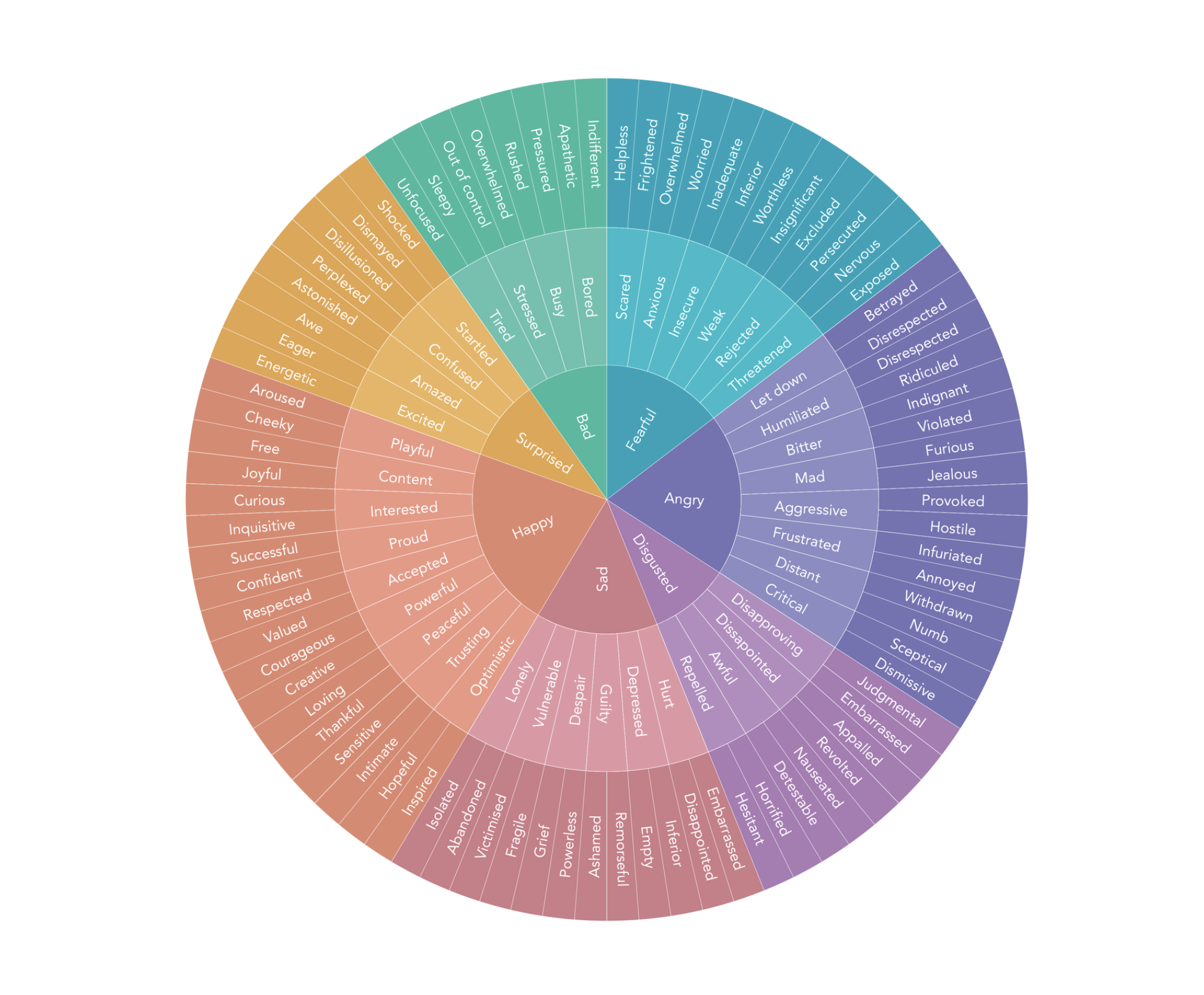
Part of getting to know our feelings includes locating where you feel it in your body, and what sensation you feel in that part of your body. Is it burning? Is it boiling? Is it buzzing? Is it nauseating? Now give the feeling a name — this might be the actual word for the emotion such as anger or it could be defined as a colour, a person, a smell, a flavour.
The Calm app (pictured) has a ‘wheel of emotions’ which is a useful resource to help you name/label your emotions. This is great to use with children too to give them the skills at an early age, that help them develop emotional awareness and eventually maturity.
Can you try to understand what it’s trying to tell you?
2. Can you just sit with the feeling until it passes instead of ignoring or pushing it down?
Feelings may be big but they are not permanent, they come and they go. As Buddha says:
“Nothing is permanent. If you allow them to be acknowledged, you also give yourself the chance to let them go.”
To help you sit with them and pay attention without letting them overrun you, you can practise breathing exercises to help calm the nervous system, as well as use positive affirmations, sounds/music and journaling.
A big hug works wonders — this is deep pressure and connection at its simplest in my view! You can hug yourself too if there is no one around. That’s self-soothing.
Weighted blankets are another soothing option. The weight helps to provide a sense of deep pressure and wrapping it around you creates a cocooning sense of safety.
3. Be open and look out for other forms of creating a sense of safety to sit with, process and let go of emotions
A co-regulating person is wonderful if you can find them. They regulate themselves and allow you to feel regulated because of their presence. I have had many wonderful teachers, guides and coaches who have been a co-regulating presence. That has meant that I can now co-regulate, through extremely challenging times of crisis, for the important people in my life — my kids, my partner, family and my clients.
So, who is your compassionate co-regulator?
Or maybe for you it’s an animal or pet. Dogs, cats and horses are all known to be therapeutic!
If you haven’t found someone yet, stay open to the idea of finding or accepting the support of a co-regulator. It will do wonders — not just for you — like a flame that can light other candles, you get to share that gift with other people in your life.
Big emotions don’t mean you’re broken. They mean you’re feeling. And feeling is human.
Emotional regulation isn’t about suppression. It’s about learning to pause, connect, and honour what’s true.
If you’re neurodivergent, gifted, or emotionally sensitive — you deserve tools that work with your system, not against it.
This is the work we do in 1:1 coaching. If you're curious, you're welcome here.
This is part of a monthly series on neurodivergence, burnout, and healing. Subscribe to the newsletter for stories and tools that meet you where you are.
May you be the light that the world needs.
